
More Theatre News
-
Review: Mrs Doubtfire at Birmingham Hippodrome
Posted on Fri 21 Aug
-
Birmingham Rep's production of Sweeney Todd breaks box office records
Posted on Thu 20 Aug
-

Feature: Feelgood Factor
Posted on Thu 20 Aug

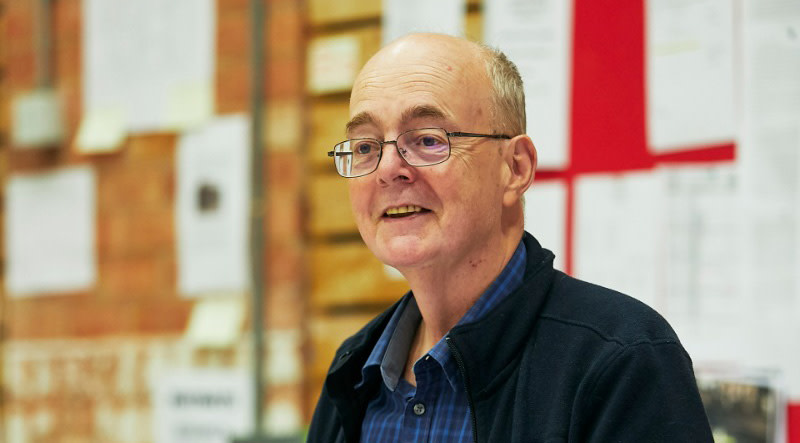
Midlands playwright David Edgar has had a decades-long relationship with the Royal Shakespeare Company (RSC), with 10 of his plays having been produced by the theatre over the last half century. At this year’s RSC Summer School, he led a session exploring politically engaged theatre and the legacy of the RSC’s first female director, Buzz Goodbody, who died by suicide in 1975, aged 28.
David here looks back to the very beginning of his journey with the Company - the premiere of Destiny, a politically charged play about the influence of the National Front, which opened at RSC venue The Other Place in Stratford-upon-Avon in 1976...
David, what’s your history with theatre in the region?
I’ve lived in the Midlands all my life. As young actor/stage managers, my parents met on the stage-door steps of the Birmingham Rep, and my aunt Nancy Burman was Rep director Barry Jackson’s production manager when he was director of the Shakespeare Memorial Theatre - now the Royal Shakespeare Company - in the late 1940s.
The second Shakespeare play I saw was As You Like It at Stratford. Now I’m the RSC’s most premiered playwright. It’s been my life.
Four of my 10 RSC plays started life at [RSC venue] The Other Place, but three of them went on to other theatres, including London and the RSC’s partner theatre in Newcastle. In the 70s and 80s, you could have the intimacy and audience involvement of a small theatre but still have a large cast: even now, my 2014 play, The New Real, had a cast of nine. The Other Place has historically provided the best of both worlds.
What’s the value of having an experimental space like The Other Place within a major national theatre institution?
When he founded the RSC, Peter Hall wanted Shakespeare to influence new experimental work and visa versa - thematically, artistically and directly - by new and classical productions sharing actors and creatives. I think that’s been achieved. The Other Place is probably the best small theatre in England outside London - and for periods you could argue it was the best anywhere for small-scale Shakespeare and other classics, as well as new plays.
Your first play to be produced by the RSC was Destiny, which premiered at The Other Place and turns 50 this year. What prompted you to write it?
In the early 70s I was a reporter on the Bradford evening newspaper and I became increasingly alarmed by the popularity of an anti-immigration group, later to join the National Front. I wanted to find out and explain why. My ambition was for the play to go on in a big theatre in an industrial city. The play was commissioned by Nottingham Playhouse, who turned it down, and the Birmingham Rep, who programmed it, but the production was withdrawn by order of the Board. It ended up being premiered in a tin hut in rural Warwickshire, having been turned down by the RSC, a decision reversed when a young director - Ron Daniels - persuaded Trevor Nunn to let him direct it. Thank goodness.
What did you want audiences to understand about the National Front after seeing Destiny?
I wanted the play to do three things: to persuade people that the National Front was indeed a Nazi Front, run by people who had been overt, swastika-wearing fascists but who were now posing as respectable politicians; that the conspiratorial ideology that had been so successful in Europe before the war was still potent and powerful in contemporary Britain; and that the National Front was addressing a real if misdirected sense of loss and anger.
What was the reaction to the original production at The Other Place?
The play was well reviewed at Stratford and did well enough to allow the RSC to take the brave decision to transfer it to its London West End theatre, the Aldwych, where it received, largely, very enthusiastic reviews. In a review I treasure, Michael Billington wrote of it in the Guardian: “The final effect is of a play that is something more than skilful and well-written. It is one that is actually necessary.”
How did Destiny contribute to the political conversation of the time?
The play did provoke argument: a Guardian columnist challenged its analogy between 1930s Germany and 1970s Britain as grandiose, and a performance was physically attacked by a National Front breakaway group. I’m not suggesting those two responses were in any sense comparable or related. The Play For Today version, broadcast on the BBC, got - for the time - a relatively small audience, but its 2.9 million viewers obviously dwarfed any audience it could have received onstage and gave the play its greatest impact on public opinion. I saw it was part of the wider campaign to persuade voters tempted by the National Front of the party’s true origins and intentions, a campaign which contributed to its catastrophic performance at the 1979 general election.
In this year’s RSC Summer School, you commemorated the life and legacy of the theatre’s first female director, Buzz Goodbody. What was she trying to establish during her tragically brief tenure as artistic director?
Although I’d met and liked her, I came to the RSC after Buzz’s death, so I didn’t know what her ambitions were directly. The only new play programmed under her directorship was a Mike Leigh improvised drama. I think she wanted a new, younger audience, and although The Other Place audiences may well have snuck down the road to the Royal Shakespeare Theatre from time to time, there was always a feeling that The Other Place’s audience was different, partly defined by not being the main-house audience.
Do you see a direct line between the work Buzz was doing at The Other Place and the RSC's approach to new writing today?
The big change since the early glory days of The Other Place was of course the building of the Swan in 1986, and the opportunity for big, often political new plays there - from Peter Flannery’s 1989 post-war state of England play, Singer, via Fraser Grace’s 2005 Breakfast With Mugabe, to Juliet Gilkes Romero’s 2020 historical slavery drama, The Whip. Some of them - like Richard Bean’s Civil War satire The Hypocrite and Phil Porter’s Roman romp Visa Versa - both 2017 - exploited the Swan’s particular suitability for rumbustious comedy.
Why is it important to remember Buzz's contribution to British theatre, particularly for a new generation of theatre-makers?
I think the big thing The Other Place did was to break down the border between new and classical work, as Peter Hall hoped it would, to encourage and enable theatre-makers like me - who’d started out in the alternative, fringe theatre - to work on a bigger scale, inspired particularly by Shakespeare’s treatment of history. This process was a two-way street, and Buzz’s The Other Place production of Hamlet - with Ben Kingsley - showed how chamber productions with a political bent could refresh how Shakespeare was presented. Destiny shared a season with Trevor Nunn’s stark and mesmerising Macbeth - McKellen and Dench - [which was] perhaps, after the Hamlet, the best-ever example of the power of small-scale Shakespeare with big ambitions.
To find out more about the RSC’s annual Summer School, and about David’s history with the theatre, visit rsc.org.uk