
More Visual Arts News
-
Balsall Heath celebrated with new street-based artworks
Posted on Thu 10 Sep
-
Birmingham's beauty framed in new VISTA exhibition
Posted on Mon 07 Sep
-
Last chance to see Ozzy Osbourne exhibition at Birmingham Museum & Art Gallery
Posted on Wed 02 Sep
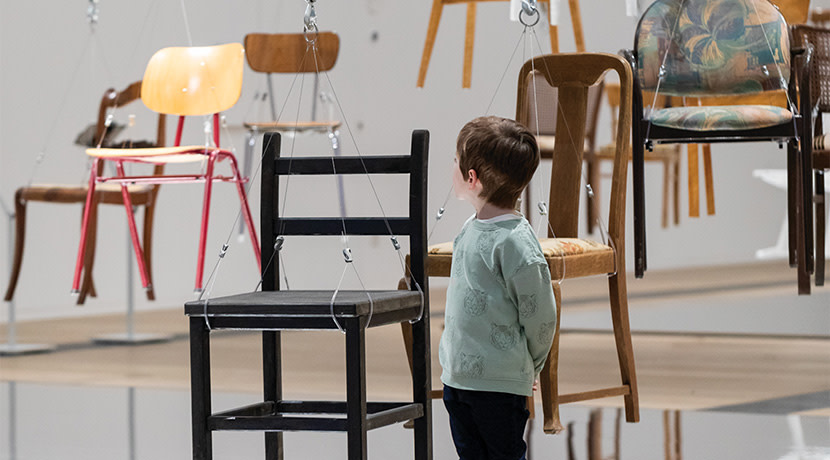
Making its UK premiere at Midlands Arts Centre (MAC), The Final Bid is an interactive exhibition which offers a new outlook on familiar objects. From late July, the venue’s first-floor gallery will exhibit a selection of chairs donated by members of the general public who have also shared the stories behind those donations. Visitors can place bids to buy whichever chair takes their fancy. Michael Pinsky, the artist behind the exhibition, is using the show to reframe the way we value the everyday items around us, and to interrupt the expected consumer process - as he told What’s On…
There are few items more ‘everyday’ than the humble chair. Whether the wheely office variety, a comfy armchair, or sturdy dining furniture, few people spend their days without interacting with a seat of some kind. This summer, courtesy of artist Michael Pinsky, a selection of chairs will find their moment in the spotlight, in a major exhibition at Midlands Arts Centre (MAC), titled The Final Bid.
The chairs, which have been given to the installation by members of the public, will be available to purchase by way of auction listings. In the months that the exhibition is on display, and as the value of each chair increases according to visitors’ bids, the chairs themselves will physically rise in the gallery - connected to the ceiling by electronic winches.
“The chairs will get nearer and nearer the ceiling,” Michael explains. “The gallery actually has quite a high ceiling, which is one of the attractions of doing the show here. At the end of the show, the people who have made the successful bids will receive the chairs. We drop them back down to the ground again, and we'll have an event where people can receive the chairs.”
It’s not just a question of aesthetics - when placing bids, visitors can read about each chair’s history. At The Final Bid’s only previous showing, the personal anecdotes behind the chairs proved to be a big hit - and the concept comes with a story of its own…
“This kind of comes from my (now dead) uncle in the States, who lived in LA,” Michael explains. “He used to do garage sales, then went into the very early days of eBay. And he would make up stories about the objects, like, ‘I found this in my grandmother's attic...’ He found that things sold much better when they were attached to a story - even though he completely lied about the stories. That's the way he was - a cheeky uncle.
“In Germany, where we showed it before, some people bought the chairs just because they really liked the chairs, but other people bought them because of the associations and the stories as well - so the narrative was as important as the object.”
Michael’s work is often created with the intention of reaching audiences who are not generally immersed in the world of art and curation. The bold messages behind his installations can be communicated in a couple of sentences. This was true with Plunge, for instance - which indicated on national monuments the predicted sea levels of the year 3012 - and also with L'eau Qui Dort, which made an artistic display of items dredged from the canals of Paris.
“Simplicity is actually very difficult to achieve. Making concepts ambiguous, obscured and complex is easy. Making something that really grips people and is simple, both in its visual manifestation and its thematics or concepts - that's actually really challenging. It's something I try and work on a lot. I come up with a lot of complicated ideas, and then I really have to strip them down.”
Environmental commentary has been a recurring theme in Michael’s work, and while The Final Bid perhaps has a more nuanced ecological message, it explores the nature of consumption, and questions whether buying new is necessary.
“I became interested in the difference between recycling and reuse. Recycling has become this kind of environmental excuse, let's call it - everyone feels quite pleased with themselves because they put their things in the recycling bin… A lot of that stuff ends up on ships travelling around the world where no one wants it.
“Another side is the amount of energy that you need to recycle. Reuse has very low energy input - very, very sustainable - but it also questions the notion of buying things in the first place. So much of what we're buying, in terms of our clothes, or the fashion of the house in this case, we just don't need it. I can't imagine anyone needing to buy a new chair.”
Admitting how easy it can be to buy new, mass-produced furniture, Michael highlights that such furniture is not made to be repaired and sustained. Instead, these often non-recyclable items are thrown away when they reach the end of their useful life.
“If you get a nice wooden table, and it’s just made of wood, nothing else, you can repair that forever; it will last forever. You can sand it down, you can re-coat it. You could get another bit of wood, you can repair it. That will last forever.”
The Final Bid aims to encourage its viewers to see the value in reuse and repair, interrupting the mass-production pipeline. Another of Michael’s works called attention to the production process in a similar way; in Making A Stand, raw wooden planks became an art installation during a year of outdoor seasoning and weathering which, at the same time, increased the wood’s value.
“I made that year of seasoning into an artwork and then put [the wood] back in the supply chain. I feel like the same principle is at play with The Final Bid - I'm actually not making anything, I'm just taking these chairs and announcing them as a kind of kinetic artwork. It's there for a period of time, and then the chairs go into a new place. I'm not offering a product, I'm offering a service… The principle is that there's nothing left. It's not just the messaging, but actually the methodology that follows those principles - some of my early artworks, they're announcing something, but I'm not following those principles in the same artwork.”
It’s not the first time Michael has exhibited work at MAC. In 2023, he displayed his immersive Pollution Pods, which replicate air pollution levels from different cities around the world. The show took place after the Arts Centre had caught his attention as a hive of creative activity.
“I didn't know about MAC before. They invited me out to look at the site. It was a Tuesday - I cycled out there, through this park, and I expected to arrive somewhere really quiet. It was full of people! They were eating there, doing this and that... I thought, wow, this is an amazing place.”
With The Final Bid aiming to spark a conversation about the value - whether financial or sentimental - which we place on ordinary items, Michael believes that MAC’s creative melting pot is the perfect place to exhibit.
“[Visitors] might be interested in doing a pottery workshop, they might be interested in catching a film, they'll catch a show. That general cultural interest is so important. It's places like MAC that are so important - and so rare nowadays - for fostering that general cultural excitement and interest. It's a seven-year-old going in there, seeing something [and thinking] ‘Oh actually, this is something I'm interested in.’ If you don't get a chance to see it, you're never going to be interested in it.”
The Final Bid shows at Midlands Arts Centre (MAC) from Saturday 25 July to Sunday 4 October
By Jessica Clixby