
More Comedy News
-
Feature: Cooking Up A Laugh
Posted on Wed 23 Sep
-

New comedy and dance shows announced at Birmingham Rep
Posted on Thu 03 Sep
-

Feature: Bostin' Tay Party
Posted on Thu 20 Aug

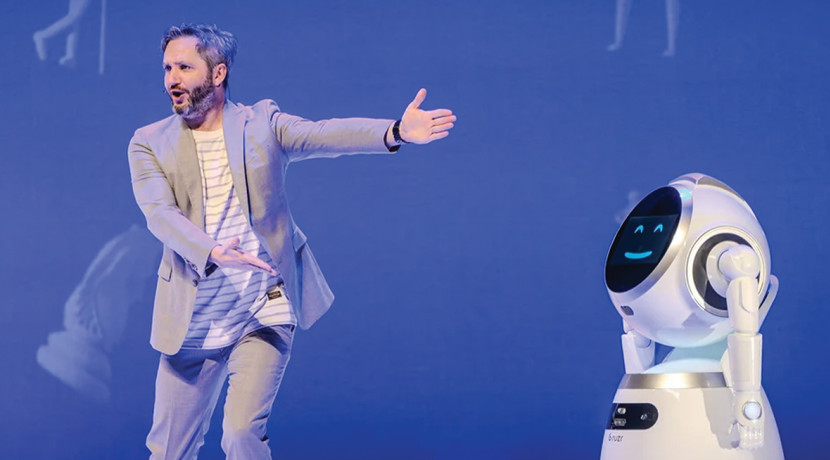
Lieven Scheire has sold out venues across Belgium and the Netherlands with his sharp mix of science and comedy. International audiences may know him from BBC’s QI, the hit podcast No Such Thing As A Fish, or from his viral science explainers online. Now, he’s bringing his acclaimed show, Artificial Intelligence, to the UK. What’s On caught up with him to talk about what’s really going on under the bonnet of AI, why humour is the perfect tool to explain tough ideas, and how he sees the future of this rapidly evolving technology...
So, what actually is AI, Lieven?
Well, turns out there is no real definition of that. You could say that the term ‘artificial intelligence’ is mostly clever marketing. It sounds like we’re talking about consciousness. In reality, it’s simply a new kind of software that’s exceptionally good at recognising patterns.
What will your show be about?
I’ll be talking about the possibilities of AI, both now and in the future. But I also want to give the audience a better understanding of what’s going on ‘under the bonnet’ of AI. Research into AI actually began back in 1956, making this field almost 70 years old now. For a long time, artificial intelligence was built on rule-based programming: the typical ‘if this, then that’ rules that you see in programming languages. But today’s wave of AI simulates a neural network in software: it is roughly based on the way a network of brain cells send signals to one another. About 10 years ago, that suddenly started working remarkably well. Tasks that old software and robotics couldn’t automate - like picking fruit or recognising faces - are now being automated by AI.
This technology moves so fast. Has your show changed since you first wrote it?
Absolutely. I follow the newest developments and adapt the show when needed. Every few months, there’s a new breakthrough in AI that changes the conversation.
Your career also seems to stretch far beyond just this show on AI. Can you tell us a bit more?
In Belgium, I develop and host TV shows on science and comedy for national television, and I’ve toured theatres with shows about special relativity, human genetics, and now AI. The concept for all of them is the same: making intriguing but complex topics accessible to a general audience. I also host Nerdland, Belgium’s biggest science podcast, as well as the Nerdland Festival, our yearly science festival that attracts 25,000 visitors. I’ve also worked abroad a bit, doing TV in the Netherlands, and some research as a QI Elf for BBC’s QI. We’ve had international guests on the podcast, such as Dara Ó Briain, Neil deGrasse Tyson, XKCD cartoonist Randall Munroe, and Walter Isaacson. I’ve also taken my shows from the Edinburgh Fringe to San Francisco, and even to CERN in Geneva. Another highlight for me was when former US president Barack Obama visited Belgium two years ago - my AI talk was the opening act before him. Quite an honour.
How important is comedy in your shows?
I started out as a stand-up comedian, which I often describe as the altitude training of public speaking. On a stand-up stage, there are no excuses. You’ve got nowhere to hide: either the crowd laughs or it doesn’t, and the buck stops with you. That kind of training makes you very aware of an audience’s attention, and makes you aim for the joke when you can. When you’re explaining complicated stuff, it certainly helps to add some lightness.
Chat GPT is also an example of this new kind of automation, this time in the field of creative and intellectual professions...
AI is the ‘loom’ of knowledge work. When weaving machines took over manual labour, they brought efficiency gains and sparked massive protests. And yet manual labour clearly hasn’t disappeared. So now the big question is: what happens when we automate brainwork? If AI really creates huge efficiency gains, we could, for example, evolve toward a four-day work week.
Will everyone soon have a robot at home?
At the moment, language models are still the main revolution within AI. Image recognition and other forms of AI are developing as well. But the ultimate goal is the creation of artificial general intelligence (AGI): an AI system that doesn’t just perform one specific task, but can do everything. Many researchers believe we’re getting closer, while others still dismiss it as a pipedream. Still, one thing seems certain: if more computing power becomes available through more efficient methods, it will almost certainly be funnelled into the race toward AGI.
In your show, you quote Yuval Harari:“I’m not afraid of artificial intelligence, but of human stupidity.” I just asked an AI system whether we should fear AI - it quickly turned very dark!
We sometimes forget that these language models are trained on everything that’s out there on the internet. Their answers echo what the average internet user writes. These language models have no consciousness. We are not even sure if that will ever be possible with this technology. We don’t even know what causes human consciousness. People today also completely misjudge the real risks of AI.
In what way?
We’re fixated on the Terminator idea. As long as we don’t see glowing red eyes, we feel reassured. Meanwhile, AI systems are already being trained to play the stock market, and military drones with facial recognition are already being sold. The real danger probably lies in corners we can’t see yet. The million-dollar question is: where’s the black swan we don’t see coming? The seemingly trivial glitch that ends up having massive consequences? In short: AI is software. It’s not a conscious, evil mastermind secretly plotting its next move. The drive to dominate, to be in control, that’s human. It’s part of our evolution. Software doesn’t have that instinctive aggression. Your PC is not angry when you turn it off.
What does the future look like?
Nobody knows! The newest large language models, like GPT-5, aren’t much better than the previous ones. Is the period of rapid progress over? Or is AGI around the corner, like some tech entrepreneurs believe? We’ll see. But AI is not a fad. Even in its current state, this is a valuable new kind of software with completely new capabilities that will not disappear from our lives and work places anytime soon.
Lieven Scheire brings his new show to the Swan Theatre, Worcester, on Thursday 12 March; Theatre Severn, Shrewsbury, on Saturday 14 March; Stafford Gatehouse on Wednesday 18 March; Lichfield Garrick Theatre on Saturday 21 March; and The Brewhouse, Burton upon Trent, on Tuesday 24 March