

More Music News
-

Gift your loved ones tickets to an event this Christmas
Posted on Mon 16 Nov
-

Download Festival announces headliners for 2027
Posted on Fri 13 Nov
-
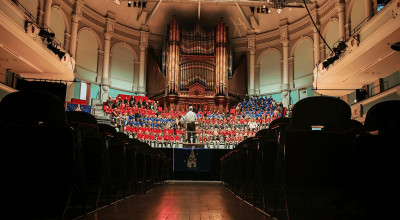
Young musicians to take centre stage at Stoke-on-Trent Christmas concerts
Posted on Thu 12 Nov

Formed in the Birmingham suburb of Moseley almost four decades ago, Britpop favourites Ocean Colour Scene are back on the road and playing some of the biggest shows of their career.
Singer Simon Fowler recalls the band’s halcyon days, as well as celebrating the 30th anniversary of seminal album Moseley Shoals...
Thirty years ago, Ocean Colour Scene were one of the biggest bands in the UK. Breakthrough album Moseley Shoals shot up the charts, spurred by a succession of hit singles, including You’ve Got It Bad, The Day We Caught The Train and The Riverboat Song. Live gigs became the stuff of legend, and the band even opened for Oasis at Knebworth.
Heady days, but three decades later the group are embarking on their biggest tour since then, following an upturn in fortunes that singer Simon Fowler is at something of a loss to explain.
“I’ve got no idea [how it happened]... it just seems like a certain sort of momentum has picked up. Two years ago, we played the NIA [aka Birmingham’s Utilita Arena] and sold it out - I didn’t think we’d be doing that again. Maybe it’s the Oasis factor - everyone’s got their bucket hats out again.”
His explanation potentially holds water, given that the band are now managed by Alan McGee, the co-founder of Creation Records, who signed Oasis and became one of the faces of Britpop - almost as much as the musicians themselves.
It’s a period in time which the legendary music-industry executive remains enraptured with, and is keen to recreate with his new charges.
“Ocean Colour Scene released Moseley Shoals at the epicentre of an incredible time for music: 1996,” says Alan. “When I was asked to manage them four years ago, we set out on a journey to celebrate their unique sound and deliver it back to the masses. This tour is their biggest in 30 years and puts them in their rightful place as one of the truly great bands of their generation.”
But if Alan is effusive, then Simon is rather more laidback about the whole affair. If he’s excited, then the genial band leader hides it well behind a laconic, self-deprecating and largely deadpan manner.
He claims he’s just as happy playing acoustic shows in smaller venues as he is playing arena gigs - he’s been touring as a double act with drummer Oscar Harrison “for probably 25 years”. And he no longer moves in rock & roll circles, preferring to live a quiet life on the outskirts of Stratford-upon-Avon.
“I’m sort of divorced from the music scene now,” he admits. “I live in a village and just go to the pub. I don’t know how to stream. I’ve never used a computer.”
Thankfully he can work a calendar, and is as bemused as anyone at how much time has passed since the band’s heyday, when their best-known album, whose title is a pun on legendary Alabama music city Muscle Shoals, was a chart fixture.
“It’s hard to believe that Moseley Shoals has turned 30 in 2026. We owe so much to that album.”
They do indeed. Released in April 1996, the LP reached number two in the UK charts, spawned four hit singles and kickstarted a career that saw the band go on a run of 17 Top 40 hits, including nine successive Top 20 singles.
“It was incredible,” says Simon. “At one point, Moseley Shoals was at number two and our B-sides album [B-sides, Seasides And Freerides] was number four.”
The band’s follow-up LP, Marchin’ Already, did even better, going straight in at number one and knocking Oasis’ Be Here Now off the top spot, prompting a typically droll response from the elder Gallagher brother.
“Noel sent us a plaque saying ‘congratulations to the second-best band in Britain’,” laughs Simon.
Ocean Colour Scene is very much a family affair these days, with Harrison’s son Leon playing percussion and guitarist Steve Cradock’s son Cass on keyboards and guitar. “He’s the pin-up of the band,” quips Simon, acutely aware that he’s known both of the ‘kids’ for most, if not all, of their lives.
He almost shudders when he realises that Leon “is in his 40s now”, and accepts that the 30th anniversary tour will naturally be a reminder of how big the band became at the height of their fame. The final show of the 21-date trek is a hometown gig at Birmingham’s bp pulse LIVE arena, a venue that holds a particularly personal memory from back in the day: “I remember the first time we played there. It was really weird because the Evening Mail, who I used to work for, sent a special truck out to the venue to sell papers that had a wraparound cover with us on it. It definitely felt like we’d made it.”
Mention of his former career as a journalist (“I wanted to be a sports reporter like John Motson, but after a while realised I wanted to be like John Lennon”) briefly takes our conversation down a rabbit hole about the decline of journalism, particularly local, and how few people read newspapers in 2026. The reason? Simon reckons it’s got a lot to do with society’s addiction to video clips on mobile phones. “One minute they’re watching rioters in Dover and the next it’s a dog doing tricks,” he laments.
It’s a far cry from when he swapped writing news stories for song lyrics in the late 80s and early 90s - including the tunes that would define the band’s career after their eponymous debut LP flopped.
“I remember that time vividly,” he recalls fondly. “We started off at Bob Lamb’s studio in King’s Heath because [Steve and I] both lived within walking distance.
“I’d write a couple of songs every night after we got back from the Jug of Ale, Snobs nightclub, the Institute or wherever. I couldn’t go to sleep without having something to work on in the studio the following day.”
The hard work might have been for nothing if not for a few well-known, and well-connected, supporters who helped advance the band’s cause. Gigs with Paul Weller paid for recording sessions (Cradock became a regular member of his backing band), Noel Gallagher gave the band a support slot on an Oasis tour after hearing some of their demos, which in turn prompted a record deal with MCA, and Chris Evans played The Day We Caught The Train to death on the Radio One breakfast show.
“We owe Chris so much,” says Simon. “He’s a really good bloke, too.”
With Evans, Weller and Oasis all still going strong 30 years later, it’s tempting to think a Britpop revival might be on the cards, and with it maybe a little of the optimism that it brought to a beleaguered Britain in 1996. Simon’s not so sure. Attending gigs is largely a chance to escape from the troubles of the world rather than debate them, and there’s no harm in that.
“It seems like everyone’s completely wrapped up with everything that’s going on at the moment, and there’s not a way [forward],” he sighs. “We’re all going to be murdered by machines anyway, so get along to a gig while you can.”
Ocean Colour Scene play bp pulse LIVE in Birmingham on Saturday 12 December. The band then play Loopfest at The Quarry in Shrewsbury on Friday 30 April.
Simon Fowlers’ The Ocean Colour Scene Songbook Tour visits The Wulfrun at The Halls Wolverhampton, on Saturday 6 March, Bilston Town Hall on 24 February 2028, Redditch Palace Theatre on 25 February 2028, Keele University on 20 April 2028, Stourbridge Town Hall on 22 April 2028 and Coventry hmv Empire on 29 April 2028.
By Steve Adams