

More Theatre News
-
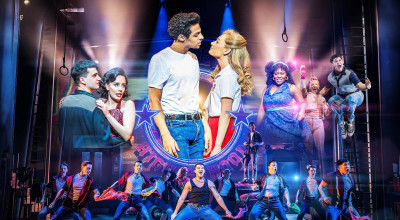
Grease The Musical comes to Stoke in 2027
Posted on Fri 20 Mar
-

Review: Fawlty Towers at The Alexandra
Posted on Wed 18 Mar
-
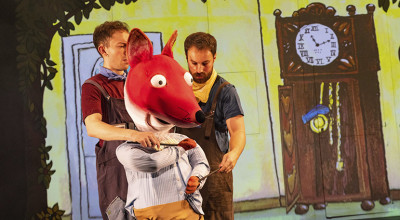
Feature: Q&A with Julia Donaldson & Axel Scheffler
Posted on Tue 17 Mar

Actor Alfred Enoch, best known for playing Dean Thomas in the Harry Potter films, takes on his biggest stage role to date when he stars as the titular king in Henry V for the Royal Shakespeare Company this month. It’s not only a fantastic part, he tells What’s On, but also one that comes with a family connection and contemporary resonance...
Alfred Enoch started his acting career young. Very young. At the age of 10 he joined the cast of Harry Potter And The Philosopher’s Stone, going on to appear as Hogwarts pupil (and child wizard) Dean Thomas in seven of the series’ eight movies between 2001 and 2011. The incredible start to his career is even more remarkable given that he initially turned down the chance to audition, as he couldn’t see a role for a young black kid. He was eventually encouraged to try out after a member of the casting department spotted him performing with the National Youth Music Theatre, and the rest is history.
In the 15 years since the last Potter film, he’s earned a degree in Modern Languages from Oxford University and developed a creditable acting CV that includes high-profile roles in TV hits such as How To Get Away With Murder, Miss Austen and recent Harlan Coben adaptation Run Away. His theatre work is arguably even more impressive and features a number of Shakespeare plays, including As You Like It, Romeo And Juliet, King Lear, Coriolanus and a critically acclaimed production of Pericles for the Royal Shakespeare Company in 2024. Henry V sees him reunite with its director, Tamara Harvey, also the RSC’s co-artistic director, who will become the first female in the company’s history to helm a production of the play.
Alfred admits her involvement is one of the main reasons he’s so excited to return.
“I had the best and the richest experience of my professional career working with Tamara on Pericles, so to come back is joyous,” he says. “The possibilities she opens up in the [rehearsal] room are unique in my experience, and I’ve been doing this for a quarter of a century. She’s an extraordinary collaborator and facilitator for the work of others - you’re not sculpting and discarding blocks of granite as you get towards a perfect shape, you’re always exploring and discovering more.
“The amount of possibility is fitting for anything, but especially in Shakespeare, where the text is so plastic - he has a way of writing that gives you so much freedom.”
Alfred concedes that rehearsals have been demanding, and despite insisting he doesn’t seek out challenging work for the sake of it, he’s been enjoying every minute: “A play of this quality gives you so many possibilities, so many provocations and so many options and avenues to explore. That’s part of its fullness, and the aliveness is what makes it so appealing to me.
“If it was easy, it wouldn’t be so rich, wouldn’t be so satisfying, and wouldn’t be so rewarding,” he adds, noting that despite being a history play with a very specific history - it centres on the Battle of Agincourt - Henry V is as much about people and power, and how they are portrayed and perceived, as the precise details of the conflict.
“Theatre is an inherently present medium - it speaks to people in the audience. Something obviously shifts when you get plays printed and you can read them at a distance, but ultimately all theatre makers understand that a play is something you make for your audience. So it seems to me - important caveat - that Shakespeare made theatre to engage with his audience and have dialogue with them, not to get all the history bang on.”
It’s been over a decade since the last RSC production of Henry V, but given recent or ongoing conflicts (Ukraine, Gaza), invasions (Venezuela) and potential invasions (Greenland) in the world, the timing of this year’s production seems sadly prescient.
“We’re living in a political moment where militaries and aggression seem even more pronounced than they have been, though sometimes we make the mistake of imagining [wars] don’t exist because they’re not in our immediate sphere.
“It feels like we in the UK and the West are even less able to sit in our bubbles and think all is well just because all is well for us.” How and if any contemporary resonances will be represented in the new production is something Alfred won’t be drawn on (“I’m not entirely sure how much I should be sharing”), but he’s rather more forthcoming about his own connections to the play. Not only was it the first stage show he ever saw, he even has cue notes written by his late father, the actor William Russell, which he found scribbled in a copy “appropriated” from his bookshelf.
“I’ve been working through an edition of Henry V that he used, and it’s been fun trying to decipher his little notes. My mum also gave me a little diary of his from that period - not a proper journal, just little lines and the dates. One said: ‘dried in the chorus speech. Oh dear.’”
The notes stem from the time his father played the King of France opposite Mark Rylance as Henry in a production that was part of the opening season of the recreated Shakespeare’s Globe in 1997. It was eight-year-old Alfie’s first exposure to the theatre, and he was instantly hooked.
“I’d always been interested in his work because my dad was much older [his father was 64 when Alfred was born], and a lot of stuff he’d done was on telly at Easter and Christmas - he was in The Great Escape and had done all sorts of war films in the 50s and 60s.
“All of this was really compelling to me, so of course I wanted to go and see what he was doing. I walked in and stood in the yard, in the groundlings, and it was like going into the past. I loved history, and the play itself was set very much at the time. It absolutely gripped my imagination, so much so that I demanded - or requested politely - that my room be painted blue, in accordance with the King of France, and I wanted a fleur-de-lys round the top.”
The experience obviously didn’t just impact his younger self’s choice of colour scheme, it changed his life - and the adult Alfred still believes live theatre has the power to transform people.
“Going to the theatre is an act of putting yourself into someone else’s shoes and someone else’s story. It’s a fundamentally empathetic act. You come along and say ‘I’m going to give my time and energy to this story - not just to receive it but to put myself into it in an active way.’ By doing that, can you come out the same? I hope the answer’s no. It’s like anything - you go somewhere new, you see something different, you’re changed. That’s what the theatre is.”
Henry V shows at the Royal Shakespeare Theatre, Stratford-upon-Avon, from Saturday 14 March to Saturday 25 April
By Steve Adams