
More Comedy News
-

The Hub at St Mary's unveils packed Autumn/Winter 2026 programme
Posted on Tue 07 Jul
-
Review: Waitress at Stoke's Regent Theatre
Posted on Tue 07 Jul
-
Interview: David Bedella talks about playing Judge Turpin in Sweeney Todd
Posted on Mon 06 Jul

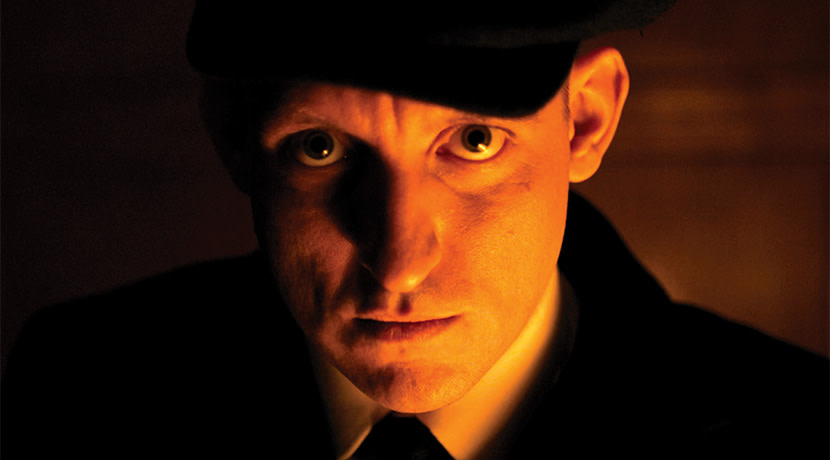
Netflix star Matthew Duckett will return to the stage and a role he knows well - despite never having performed it all the way through - when he takes the lead in the Stafford Shakespeare production of Richard III this month. It’s a chance to realise a long-held ambition as well as put his own stamp on the character, he tells What’s On...
This year’s Stafford Shakespeare production will be Richard III, the dramatic - and occasionally violent - power struggle set during the ‘winter of our discontent’ and involving one of England’s most notorious kings.
The play is effectively the finale of the Bard’s War of the Roses historical tetralogy, following Henry VI Parts One to Three. Actor Matthew Duckett, who’s playing Richard, is quick to acknowledge how a recap of earlier events - similar to the start of a new episode of a TV show - might come in handy for cast and audience alike: “We’re not staging the Henrys, so there’s a little bit of mixed storytelling that has to happen to bring the audience up to speed with who everyone is and why everyone’s so angry with each other.
“We could [go the recap route] or just throw everyone in at the deep end for five minutes and then go back and fill in the gaps. It’s been fun finding out what we want to do with it, and how we want to tell the story.”
Richard III is a play which the friendly actor knows especially well, so when he says he’s excited to be playing the lead role (“one I’ve been wanting to tackle fully for a very long time”), it’s not just the typical spiel of a performer bigging up his latest project.
Matthew might be best known for starring in the 2022 Netflix film version of Lady Chatterley’s Lover, but theatre is very much his first love, and he worked on scenes from Richard III while studying drama at Aberystwyth University.
He also understudied the role at the Royal Shakespeare Company (RSC) in Stratford in 2022.
“Theatre has always been what it’s all about for me - that sort of immediate storytelling, having the audience there, and conveying emotion or intention in the moment. I love the immediacy of theatre and the connection that you feel.”
In the case of Richard III, Matthew not only has a connection to the role but also to Richard Cheshire, who will direct the Stafford Shakespeare production at the Gatehouse Theatre.
“My first go at getting Richard III on his feet was under Richard’s direction, so it’s a bit full circle really. I was also fortunate to understudy Arthur Hughes, who became the first disabled actor to play Richard in an RSC production a few years ago. As understudy, you’re always waiting for your chance [but] as luck would have it, Arthur was the healthiest he’d ever been during the run, so I never got to step up.”
That particular version was helmed by former RSC Artistic Director Gregory Doran, working on his first production after the death of partner Anthony Sher, the actor whose award-winning portrayal of Richard is widely regarded as the greatest of all. Sher even wrote a book, Year Of The King: An Actor’s Diary And Sketchbook, to give an insight into the creation of his performance. The book has gone on to become a bible for many actors.
“Anthony’s Richard was a presence in our rehearsal room, not just for his relationship with Greg but for it being such a zeitgeist iconic role. The Year Of The King is the first book any actor turns to when they’re taking on Richard, and I think that’s been the case ever since he wrote it - it’s certainly well-leafed on my bookcase.”
But as much as he’ll take inspiration from the book, as well as the experience of working with Arthur Hughes, Matthew - who has a mild form of cerebral palsy - is especially excited to bring his own ideas to the iconic role of the ‘deformed’ king.
“To watch and understand Arthur’s process was very enlightening, but to be able to look at it afresh from my own perspective, and put my own stamp on the part, is possibly what I’m looking forward to most. And stamp I shall!”
Whether that will be in the literal sense remains to be seen, but it’s perfectly feasible, as Richard III is one of Shakespeare’s most interesting, dynamic and physical characters - gentle, charismatic and charming but with quite a nasty edge too…
“He’s incredibly charismatic but very Machiavellian, very sort of manipulative in his plotting and scheming. He wins people round with personality and wit, but equally there’s a very dark side to him.
“He’s such a great character to play. He’s very theatrical, very performative - until he isn’t. But by then you can be so swept up [by him] that you don’t quite fully understand how you got here.”
That’s a familiar pattern with a certain type of dictator, where power develops almost incrementally until one day there’s a monster in charge doing things that would have been unbelievable months, let alone years ago. The parallels with Donald Trump’s America are inevitable - Shakespeare’s work finding contemporary resonance yet again. The human condition is evidently a permanent, or at least cyclical one.
“Four hundred years on and we’re still going through the same trials and tribulations.”
The Stafford Shakespeare version of the play is set three rather than four centuries after the original, and is inspired by the 1920s gangland world of TV’s Peaky Blinders, with much of the action set around a post-world-war pub.
“There’s this world where the men are returning from great conflict, [but] how do you translate that idea for a modern audience?
“We thought post-World War One would be a good foothold for conveying the extent of brutality and man-on-man violence that goes on in the latter parts of the Henrys and through Richard. And the narrative of wanting to climb through an almost Mafia-esque family is quite a neat mirror to hold up to the royal ascendancy that Richard tries to fight his way up.”
As for ‘man-on-man violence’ - can audiences expect much in the way of Peaky Blinders-style action?
“I can’t say too much, and I don’t want to say ‘violent’, but I think the audience might worry for us in a couple of places! It’s certainly not a PG piece, but not so grotesque as to make anyone leave.
“We have high hopes for some of the fight scenes and - no spoilers - some of the deaths!”
Richard III shows at Stafford Gatehouse from Tuesday 23 June to Saturday 4 July.
By Steve Adams