
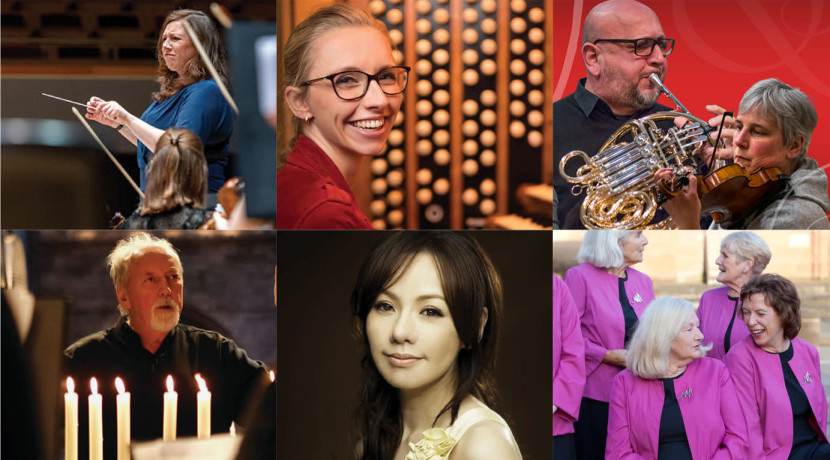
This late-month City of Birmingham Symphony Orchestra concert features three musical responses to world events. The programme commences with Iman Habibi’s Zhiân, a work composed as a reaction to state brutality in Iran.
The 10-minute piece is followed by Erich Wolfgang Korngold’s Violin Concerto, written in 1945. Korngold had vowed to compose only film music until the Nazis were defeated, so the concerto was written in response to the end of the Second World War.
The concert’s final work is Prokofiev’s Fifth Symphony, premiered in 1945. An optimistic composition, it was interpreted by many as a symbol of victory in the war.
Since its formation 80 years ago, the RPO has operated under the directorship of some of the world’s most respected conductors, Rudolf Kempe and Andre Previn among them.
Based in the beautiful surroundings of Chelsea’s Cadogan Hall, the orchestra is no stranger to the recording studio, regularly laying down soundtracks for films and enjoying a long partnership with many of the major commercial record companies...
The RPO’s late-month concert in Coventry features three works: contemporary composer Samy Moussa’s mournful Adgilis Deda; Strauss’ Four Last Songs, written when the composer was 84 years old; and Sibelius’ Second Symphony, perhaps best known for its triumphant closure.
The orchestra is joined for the concert by multi-award-winning South African soprano Masabane Cecilia Rangwanasha (pictured).
Kevin John Edusei, the RPO’s conductor-in-residence for the current season, is the man with the baton.
The Manchester-based Halle is renowned for its affinity with English music, but here turns its attention in different directions; namely Strauss’ Serenade In E-flat Major and Brahms’ Fourth Symphony. Tom Borrow (pictured) stays over from his Piano Masters recital the previous day to perform Tchaikovsky’s first Piano Concerto.
Orchestra Of The Swan make their third appearance of the season at Warwick Hall, presenting a concert that climaxes with a performance of Beethoven’s Fifth - a composition widely considered to be among the greatest symphonies ever written.
The concert takes the title Four Notes And The Truth. The four notes referred to are the four with which Beethoven begins the symphony. Often described as ‘fate knocking at the door’, they are considered to be among the most dramatic and instantly recognisable notes in the whole history of music.
The concert programme also features Holst’s St Paul’s Suite, Peter Maxwell Davies’ Farewell To Stromness, and Elgar’s Cello Concerto. The latter is performed by BBC Radio Three New Generation Artist Sterling Elliott. Andrew Griffiths conducts.
Music Director Kazuki Yamada and his CBSO head down the road to Coventry early this month to perform two epic works...
Alongside Mussorgsky’s Pictures At An Exhibition, the orchestra also embrace the challenge of Tchaikovsky’s First Piano Concerto. They are joined for the endeavour by Canadian pianist Bruce Liu.
Although nowadays one of the most famous pieces ever written for piano and orchestra, the concerto was severely criticised when Tchaikovsky first played it; his friend, Nicolai Rubinstein - his superior at the Moscow Conservatory - dealt him a crushing blow.
“It appeared that my concerto was worthless,” the composer later wrote, in recalling Rubinstein’s response, “that it was unplayable, that passages were trite, awkward, and so clumsy that it was impossible to put them right, that as a composition it was bad and tawdry... and that there were only two or three pages that could be retained, and that the rest would have to be scrapped or completely revised.”
It says much for the ultimately irrefutable quality of the concerto that the critical Rubinstein went on to become one of its biggest champions.
Performing more than 90 international concerts each year, Carducci are one of the most successful string quartets in the business, garnering lavish praise wherever they play... This latest Shropshire Music Trust concert sees them performing the following programme: Mozart’s String Quartet No19 in C major, K.465 ‘Dissonant’; Phillip Glass’ String Quartet No3 ‘Mishima’; and Shostakovich’s String Quartet No2 in A major, Op 68 no2.
The well-established London Chamber Ensemble are here presenting the second of two concerts during the 2025/26 season.
This month’s performance brings together concert-hall favourites with neglected compositions by British composers.
The programme opens with John Ireland’s Piano Trio No2 in E minor and finishes with Johannes Brahms’ Piano Trio in B major, Op8. Between the two is Clara Schumann’s Piano Trio in G minor, Op17, a work often cited as one of her most mature compositions.
Now in its 86th year, the Warwickshire Symphony Orchestra presents its Spring concert.
Richard Jenkinson takes the baton as the orchestra play their way through the music of Copland (Fanfare For The Common Man), Rimsky-Korsakov (Overture On Russian Themes), Brahms (Violin Concerto) and Beethoven (Seventh Symphony). The soloist is Callum Smart.
In the run-up to Holy Week, one of the city’s oldest musical groups here gets its teeth into the challenge of performing a trio of larger-scale works by three leading 16th-century composers: Carlo Gesualdo (Tenebrae Responsories for Holy Saturday), Dominique Phinot (Incipit oratio Jeremiae prophetae) and Thomas Tallis (Lamentations of Jeremiah).
The concert also features complementary readings by the Archbishop of Birmingham - Bernard Longleyand - and a series of shorter choral works.
Martyn Rawles is the organist whilst Paul Spicer conducts.
Mela Guitar Quartet recently celebrated a decade of musicmaking together, during which time they’ve garnered plenty of plaudits and gained an international reputation for their highly imaginative programming. This mid-month concert sees them showcasing arrangements of works for full orchestra - from Glinka’s Overture Ruslan & Ludmilla and Ravel’s Mother Goose Suite, to smaller-scale pieces like Debussy’s Arabesques for solo piano.
Masterful practitioners when it comes to playing the core quartet repertoire, Amsterdam-based Dudok aren’t shy of swimming in less familiar waters too.
On this occasion, they’re joined by brilliant Dutch cellist Pieter Wispelwey for a concert which features works by Dowland (Lachrimae or Seven Tears), Mozart (String Quartet No21 in D major, K575 ‘Prussian’) and Schubert (String Quintet in C major, D956).
Worcester Festival Choral Society’s 140 voices take on the challenge of arguably the mightiest of all choral spectaculars: Mendelssohn’s Elijah. They are joined for the occasion by four talented soloists and the Meridian Sinfonia orchestra.
Worcester Cathedral’s director of music, Samuel Hudson, is the conductor.
Performing a repertoire that encompasses a wide variety of music, Shrewsbury-based chamber choir The Phoenix Singers are this month marking their 60th anniversary with a performance of Bach’s St John Passion. Although more modest in its conception than the composer’s epic St Matthew Passion, the work is highly regarded for containing some of the most beautiful and lyrical moments of Bach’s entire output. Mark Dobell of The Sixteen takes on the role of the Evangelist. Noxwode Baroque, on period instruments, also contribute.
BIRMINGHAM FESTIVAL CHORAL SOCIETY: A SEA SYMPHONY
Leamington Chamber Orchestra here team up with Birmingham Festival Choral Society to present a performance of Ralph Vaughan Williams’ A Sea Symphony.
The concert programme also features Charles Villiers Stanford’s Songs Of The Fleet, a song cycle celebrating Britain’s strong naval tradition.
Founded more than 60 years ago, the Stratford-upon-Avon Symphony Orchestra present programmes of music from the 17th through to the 20th century.
Their programme for this latest concert sees them performing the music of Brahms, Dvorak, Mozart and Glazunov.
Now here’s a concert with a difference, featuring, as it does, original choreography designed to bring a visual dimension to the music.
The Birmingham-based Kimichi Symphony Orchestra - which last spring enjoyed a major Symphony Hall hit with Igor Stravinsky’s Diaghilev ballets - here returns to the venue to present an afternoon concert featuring three Richard Strauss masterpieces: Till Eulenspiegel, Tod und Verklarung, and Ein Heldenleben. The first two of the three compositions will be re-imagined through a cultural-fusion collaboration with the Sujata Banerjee Dance Company.
Organist Thomas Trotter has performed with a host of revered conductors and appeared alongside many of the world’s leading orchestras. Thomas was appointed Birmingham City Organist in 1983, and remains one of the country’s most acclaimed musicians. He is here joined by Gloucester Cathedral Choir to perform Fauré’s Requiem, in a concert to mark Easter Week.
Founded 25 years ago by organist and conductor Christopher Monks, and using authentic period instruments, Warwick-based baroque consort Armonico this month turn their talents to the task of performing St Matthew Passion.
A favourite at Easter, Bach’s dramatic telling of the Passion of Christ continues to be among classical music’s most profound experiences. Christopher Monks takes the reins for both performances.
Residing at the Corporation’s Manchester home of Media City, the BBC Philharmonic visits the Potteries late this month in the company of soloist Senja Rummukainen, who will be performing Dvorak’s ever-popular Cello Concerto. The programme also features Debussy’s L’après-midi d’un faune and Mozart’s Prague symphony.
Lucie LeGuay (pictured) is the conductor.
Bringing together musicians from across the Midlands, the well-established Birmingham Gay Symphony Orchestra here takes its audience on ‘a sweeping journey from Beethoven’s Ruins Of Athens Overture to Sibelius’ glorious Symphony No2’. Sandwiched in-between these much-admired works is a performance of Ney Rosauro’s Marimba Concerto No1.
The composition will be performed by soloist Andrew Woolcock, a former BBC Young Musician of the Year winner.
It’s no exaggeration to say that this is a concert which no self-respecting classical music enthusiast would want to miss.
The London Philharmonic are here performing to the baton of Tan Dun (pictured), whose CV includes the Academy Award-winning soundtrack to Ang Lee’s year-2000 martial-arts film, Crouching Tiger, Hidden Dragon...
And the concert programme makes this late-afternoon event an even more mouthwatering prospect. Alongside Beethoven’s visionary Ninth Symphony, the orchestra will also perform Tan Dun’s brand-new choral concerto, Nine. A tribute to Beethoven, the work combines ancient poetry from China and Europe, creating an ‘ode to peace’ which has been described as ‘worthy of Beethoven’s Ode To Joy’ (the fourth and final movement of the Ninth Symphony).
The London Philharmonic Choir and London Chinese Philharmonic Choir also make telling contributions to the concert, as do four talented soloists: Elizabeth Watts (soprano), Hongni Wu (mezzo-soprano), John Findon (tenor) and Dingle Yandell (bass).
CBSO: KORNGOLD & PROKOFIEV
This late-month City of Birmingham Symphony Orchestra concert features three musical responses to world events. The programme commences with Iman Habibi’s Zhiân, a work composed as a reaction to state brutality in Iran.
The 10-minute piece is followed by Erich Wolfgang Korngold’s Violin Concerto, written in 1945. Korngold had vowed to compose only film music until the Nazis were defeated, so the concerto was written in response to the end of the Second World War.
The concert’s final work is Prokofiev’s Fifth Symphony, premiered in 1945. An optimistic composition, it was interpreted by many as a symbol of victory in the war.
Symphony Hall, Birmingham, Wednesday 25 February
THE ROYAL PHILHARMONIC ORCHESTRA
Since its formation 80 years ago, the RPO has operated under the directorship of some of the world’s most respected conductors, Rudolf Kempe and Andre Previn among them.
Based in the beautiful surroundings of Chelsea’s Cadogan Hall, the orchestra is no stranger to the recording studio, regularly laying down soundtracks for films and enjoying a long partnership with many of the major commercial record companies...
The RPO’s late-month concert in Coventry features three works: contemporary composer Samy Moussa’s mournful Adgilis Deda; Strauss’ Four Last Songs, written when the composer was 84 years old; and Sibelius’ Second Symphony, perhaps best known for its triumphant closure.
The orchestra is joined for the concert by multi-award-winning South African soprano Masabane Cecilia Rangwanasha (pictured).
Kevin John Edusei, the RPO’s conductor-in-residence for the current season, is the man with the baton.
Warwick Arts Centre, Coventry, Friday 27 February
HALLE ORCHESTRA: TCHAIKOVSKY'S PIANO MASTERPIECE
The Manchester-based Halle is renowned for its affinity with English music, but here turns its attention in different directions; namely Strauss’ Serenade In E-flat Major and Brahms’ Fourth Symphony. Tom Borrow (pictured) stays over from his Piano Masters recital the previous day to perform Tchaikovsky’s first Piano Concerto.
Victoria Hall, Stoke-on-Trent, Friday 27 February
ORCHESTRA OF THE SWAN
Orchestra Of The Swan make their third appearance of the season at Warwick Hall, presenting a concert that climaxes with a performance of Beethoven’s Fifth - a composition widely considered to be among the greatest symphonies ever written.
The concert takes the title Four Notes And The Truth. The four notes referred to are the four with which Beethoven begins the symphony. Often described as ‘fate knocking at the door’, they are considered to be among the most dramatic and instantly recognisable notes in the whole history of music.
The concert programme also features Holst’s St Paul’s Suite, Peter Maxwell Davies’ Farewell To Stromness, and Elgar’s Cello Concerto. The latter is performed by BBC Radio Three New Generation Artist Sterling Elliott. Andrew Griffiths conducts.
Warwick Hall, Tuesday 3 March
CITY OF BIRMINGHAM SYMPHONY ORCHESTRA
Music Director Kazuki Yamada and his CBSO head down the road to Coventry early this month to perform two epic works...
Alongside Mussorgsky’s Pictures At An Exhibition, the orchestra also embrace the challenge of Tchaikovsky’s First Piano Concerto. They are joined for the endeavour by Canadian pianist Bruce Liu.
Although nowadays one of the most famous pieces ever written for piano and orchestra, the concerto was severely criticised when Tchaikovsky first played it; his friend, Nicolai Rubinstein - his superior at the Moscow Conservatory - dealt him a crushing blow.
“It appeared that my concerto was worthless,” the composer later wrote, in recalling Rubinstein’s response, “that it was unplayable, that passages were trite, awkward, and so clumsy that it was impossible to put them right, that as a composition it was bad and tawdry... and that there were only two or three pages that could be retained, and that the rest would have to be scrapped or completely revised.”
It says much for the ultimately irrefutable quality of the concerto that the critical Rubinstein went on to become one of its biggest champions.
Warwick Arts Centre, Coventry, Thursday 5 March
CARDUCCI STRING QUARTET
Performing more than 90 international concerts each year, Carducci are one of the most successful string quartets in the business, garnering lavish praise wherever they play... This latest Shropshire Music Trust concert sees them performing the following programme: Mozart’s String Quartet No19 in C major, K.465 ‘Dissonant’; Phillip Glass’ String Quartet No3 ‘Mishima’; and Shostakovich’s String Quartet No2 in A major, Op 68 no2.
Maidment Building, Shrewsbury School, Friday 6 March
LONDON CHAMBER ENSEMBLE TRIO
The well-established London Chamber Ensemble are here presenting the second of two concerts during the 2025/26 season.
This month’s performance brings together concert-hall favourites with neglected compositions by British composers.
The programme opens with John Ireland’s Piano Trio No2 in E minor and finishes with Johannes Brahms’ Piano Trio in B major, Op8. Between the two is Clara Schumann’s Piano Trio in G minor, Op17, a work often cited as one of her most mature compositions.
Ludlow Assembly Rooms, South Shropshire, Thursday 12 March
WARWICKSHIRE SYMPHONY ORCHESTRA
Now in its 86th year, the Warwickshire Symphony Orchestra presents its Spring concert.
Richard Jenkinson takes the baton as the orchestra play their way through the music of Copland (Fanfare For The Common Man), Rimsky-Korsakov (Overture On Russian Themes), Brahms (Violin Concerto) and Beethoven (Seventh Symphony). The soloist is Callum Smart.
All Saints Church, Leamington Spa, Saturday 14 March
BIRMINGHAM BACH CHOIR
In the run-up to Holy Week, one of the city’s oldest musical groups here gets its teeth into the challenge of performing a trio of larger-scale works by three leading 16th-century composers: Carlo Gesualdo (Tenebrae Responsories for Holy Saturday), Dominique Phinot (Incipit oratio Jeremiae prophetae) and Thomas Tallis (Lamentations of Jeremiah).
The concert also features complementary readings by the Archbishop of Birmingham - Bernard Longleyand - and a series of shorter choral works.
Martyn Rawles is the organist whilst Paul Spicer conducts.
St Chad’s Cathedral, Birmingham, Saturday 14 March
MELA GUITAR QUARTET
Mela Guitar Quartet recently celebrated a decade of musicmaking together, during which time they’ve garnered plenty of plaudits and gained an international reputation for their highly imaginative programming. This mid-month concert sees them showcasing arrangements of works for full orchestra - from Glinka’s Overture Ruslan & Ludmilla and Ravel’s Mother Goose Suite, to smaller-scale pieces like Debussy’s Arabesques for solo piano.
Royal Birmingham Conservatoire, Thursday 19 March
DUDOK QUARTET & PIETER WISPELWEY
Masterful practitioners when it comes to playing the core quartet repertoire, Amsterdam-based Dudok aren’t shy of swimming in less familiar waters too.
On this occasion, they’re joined by brilliant Dutch cellist Pieter Wispelwey for a concert which features works by Dowland (Lachrimae or Seven Tears), Mozart (String Quartet No21 in D major, K575 ‘Prussian’) and Schubert (String Quintet in C major, D956).
Holy Trinity Church, Leamington Spa, Friday 20 March
WORCESTER FESTIVAL CHORAL SOCIETY
Worcester Festival Choral Society’s 140 voices take on the challenge of arguably the mightiest of all choral spectaculars: Mendelssohn’s Elijah. They are joined for the occasion by four talented soloists and the Meridian Sinfonia orchestra.
Worcester Cathedral’s director of music, Samuel Hudson, is the conductor.
Worcester Cathedral, Saturday 21 March
THE PHOENIX SINGERS
Performing a repertoire that encompasses a wide variety of music, Shrewsbury-based chamber choir The Phoenix Singers are this month marking their 60th anniversary with a performance of Bach’s St John Passion. Although more modest in its conception than the composer’s epic St Matthew Passion, the work is highly regarded for containing some of the most beautiful and lyrical moments of Bach’s entire output. Mark Dobell of The Sixteen takes on the role of the Evangelist. Noxwode Baroque, on period instruments, also contribute.
The Abbey, Shrewsbury, Saturday 21 March
BIRMINGHAM FESTIVAL CHORAL SOCIETY: A SEA SYMPHONY
Leamington Chamber Orchestra here team up with Birmingham Festival Choral Society to present a performance of Ralph Vaughan Williams’ A Sea Symphony.
The concert programme also features Charles Villiers Stanford’s Songs Of The Fleet, a song cycle celebrating Britain’s strong naval tradition.
Image credit: Michael Whitefoot
All Saints Church, Leamington Spa, Saturday 21 March
STRATFORD UPON AVON SYMPHONY ORCHESTRA
Founded more than 60 years ago, the Stratford-upon-Avon Symphony Orchestra present programmes of music from the 17th through to the 20th century.
Their programme for this latest concert sees them performing the music of Brahms, Dvorak, Mozart and Glazunov.
Greig Hall, Alcester, Sunday 22 March
RICHARD STRAUSS SPECTACULAR
Now here’s a concert with a difference, featuring, as it does, original choreography designed to bring a visual dimension to the music.
The Birmingham-based Kimichi Symphony Orchestra - which last spring enjoyed a major Symphony Hall hit with Igor Stravinsky’s Diaghilev ballets - here returns to the venue to present an afternoon concert featuring three Richard Strauss masterpieces: Till Eulenspiegel, Tod und Verklarung, and Ein Heldenleben. The first two of the three compositions will be re-imagined through a cultural-fusion collaboration with the Sujata Banerjee Dance Company.
Symphony Hall, Birmingham, Sunday 22 March
THOMAS TROTTER AND GLOUCESTER CATHEDRAL CHOIR
Organist Thomas Trotter has performed with a host of revered conductors and appeared alongside many of the world’s leading orchestras. Thomas was appointed Birmingham City Organist in 1983, and remains one of the country’s most acclaimed musicians. He is here joined by Gloucester Cathedral Choir to perform Fauré’s Requiem, in a concert to mark Easter Week.
Birmingham Town Hall, Monday 23 March
ARMONICO CONSORT: ST MATTHEW PASSION
Founded 25 years ago by organist and conductor Christopher Monks, and using authentic period instruments, Warwick-based baroque consort Armonico this month turn their talents to the task of performing St Matthew Passion.
A favourite at Easter, Bach’s dramatic telling of the Passion of Christ continues to be among classical music’s most profound experiences. Christopher Monks takes the reins for both performances.
Malvern Theatres, Worcestershire, Tuesday 24 March; Collegiate Church of St Mary, Warwick, Thursday 26 March
BBC PHILHARMONIC ORCHESTRA
Residing at the Corporation’s Manchester home of Media City, the BBC Philharmonic visits the Potteries late this month in the company of soloist Senja Rummukainen, who will be performing Dvorak’s ever-popular Cello Concerto. The programme also features Debussy’s L’après-midi d’un faune and Mozart’s Prague symphony.
Lucie LeGuay (pictured) is the conductor.
Victoria Hall, Stoke-on-Trent, Friday 27 March
BIRMINGHAM GAY SYMPHONY ORCHESTRA
Bringing together musicians from across the Midlands, the well-established Birmingham Gay Symphony Orchestra here takes its audience on ‘a sweeping journey from Beethoven’s Ruins Of Athens Overture to Sibelius’ glorious Symphony No2’. Sandwiched in-between these much-admired works is a performance of Ney Rosauro’s Marimba Concerto No1.
The composition will be performed by soloist Andrew Woolcock, a former BBC Young Musician of the Year winner.
St Paul’s Church, Birmingham, Saturday 28 March
TAN DUN & THE LONDON PHILHARMONIC ORCHESTRA
It’s no exaggeration to say that this is a concert which no self-respecting classical music enthusiast would want to miss.
The London Philharmonic are here performing to the baton of Tan Dun (pictured), whose CV includes the Academy Award-winning soundtrack to Ang Lee’s year-2000 martial-arts film, Crouching Tiger, Hidden Dragon...
And the concert programme makes this late-afternoon event an even more mouthwatering prospect. Alongside Beethoven’s visionary Ninth Symphony, the orchestra will also perform Tan Dun’s brand-new choral concerto, Nine. A tribute to Beethoven, the work combines ancient poetry from China and Europe, creating an ‘ode to peace’ which has been described as ‘worthy of Beethoven’s Ode To Joy’ (the fourth and final movement of the Ninth Symphony).
The London Philharmonic Choir and London Chinese Philharmonic Choir also make telling contributions to the concert, as do four talented soloists: Elizabeth Watts (soprano), Hongni Wu (mezzo-soprano), John Findon (tenor) and Dingle Yandell (bass).
Symphony Hall, Birmingham, Sun 29 March