
More Visual Arts News
-

Feature: Dread Naught
Posted on Wed 23 Sep
-
-
Coventry to host landmark British Art Show 10
Posted on Wed 16 Sep

Birmingham-based painter Shaun Morris explores empty and everyday spaces across the West Midlands, which aren’t typically visited as destinations but passed through.
However, with his magical realist style, he captures their poetic beauty, and invites viewers to spend time in them, often by nightfall.
For his major solo show at the Herbert Art Gallery & Museum in Coventry, Shaun Morris has visited late night truck stops, his local high street, and Birmingham’s parks. Both rural and urban scenes appear in 15 oil paintings, which the artist has made over the last decade.
Among the show’s highlights is a large-scale oil on canvas, ‘A Minor Place’, 2016. Figureless, it features purple crates stacked high, as if awaiting their fate, and an onward journey. They sit beneath the motorway, under inky black night’s sky, in a no man’s land which has been painted pear green. It’s like a cinematic frame in a wider story: what will happen next?
Through his painterly style, Morris manipulates a sense of ambiguity. Working at the intersection of abstraction and realism, his visual language, just like his pictured sites, is that of an in-betweenness. Layering personal memories, shared stories and collective histories, he paints pictures with possibilities.
An inspiration for this body of work was the book ‘Edgelands’, in which poets Paul Farley and Michael Symmons Roberts reframe gravel pits, business parks and landfill sites as richly mysterious, forgotten regions in our midst. The edgelands - those familiar yet ignored spaces which are neither city nor countryside - are great, wild places on our doorsteps.
Walking through such spaces with his camera, Morris does stop to appreciate the beauty on his doorstep. Having grown up in the Black Country, he witnessed its deindustrialisation during the 70s and 80s. Factories disappeared, sites were abandoned, landscapes unoccupied. But even in geometric patterns of motorway bridges, he finds the everyday sublime.
From his nocturnal photographs, he painted a series of 5 parked post office vans, ‘Permanent Red’ 2024 25, with vehicles sat beneath street lights, or glow from nearby home. Everyday scenes become evocative vignettes of contemporary life.
He has also portrayed lorries on the curb side, and delivery trucks stopped on the street. As well as evoking a sense of people just passing through, these symbolic paintings shine a light on invisible, low paid workers, often stuck in the gig economy, acting as portraits of men whose work is undervalued by society.
His working-class background and roots inform his world view and approach to painting – he lays witness to the overlooked.
Morris has also painted men on his local high street, including a youngster stood on the edge of a vape shop. Once again, he pictures a threshold, between the outside street and inside store. Surrounded by abstracted geometry of the goods for sale, in repeated colours, the mundane event has been reframed as something memorable.
Elsewhere, he’s focused on a man, back turned, waiting in line at the cinema. Interactions with the devices we get lost in is a recurring theme, and reveals Morris as a great observer of contemporary life. Rather than simply document action, the artist leaves viewer to decide on their own narratives.
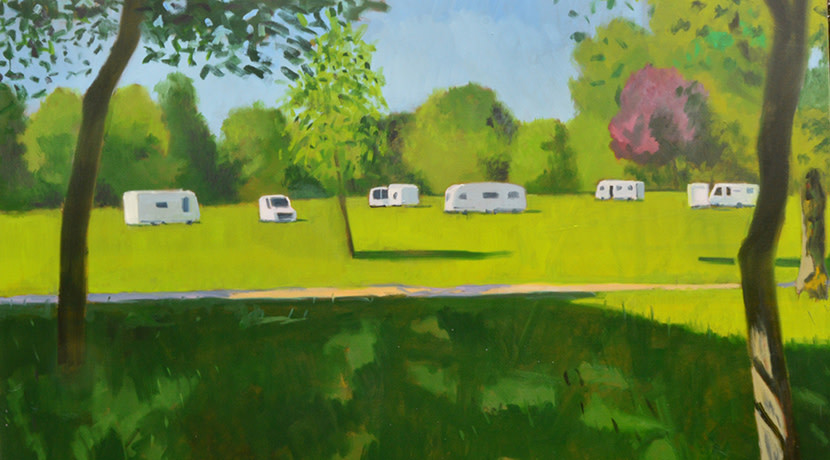
From the shadows beneath the trees, in ‘The Others’ 2025, a picturesque sun-drenched park is populated by caravans, as travellers have moved onto the land. No figures can be seen, and he keeps these people at a distance, hinting at our typically outsider view of transitory communities who pass through.
In an accompanying painting, he’s framed a group of people beneath the tall trees at the far end of the park. They stand in a circle, some of them holding hands, as if involved in some sort of ritual, with patterns of light and shade dancing on the grass below. A folkloric quality defines scenes such as these, which again invite the viewer to decide what’s happening.
Shaun Morris: Autofictions shows at The Herbert Art Gallery & Museum from 2-14 March. For more information, visit: shaunmorrisart.blogspot.com