
The Midlands Essential Entertainment Guide
Get the latest updates, offers and competitions from What's On...
The Midlands Essential Entertainment Guide
Get the latest updates, offers and competitions from What's On...
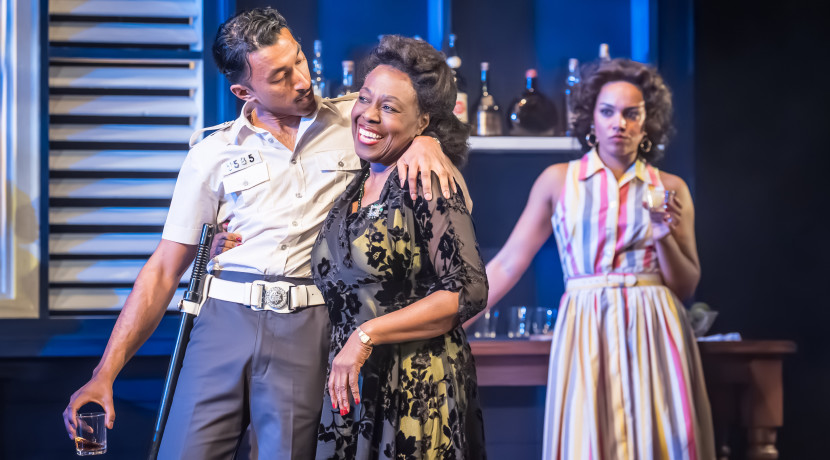






One wrong move and everything could shatter
A ‘deeply evocative’ tale of self-determination, family and belonging, set against the backdrop of a 1950s colonial Trinidad on the edge of political independence, Driftwood is the debut play from Casualty, Holby City and EastEnders actor Martina Laird. The production is helmed by Chichester Festival Theatre’s artistic director, Justin Audibert.
“The play grew from a deep desire to explore inherited patterns, the desire for connection and self-determination,” explains Martina, “and [also] to place Caribbean voices and histories at the centre of the story. To see these characters brought to life by such a generous and gifted ensemble, and under Justin’s direction, feels profoundly moving.”
Brand new production Driftwood shows at the Royal Shakespeare Company’s (RSC) fringe venue, The Other Place, this month. The debut play from Casualty, Holby City and EastEnders actor Martina Laird, Driftwood is an emotional family drama, set in colonial Trinidad in the 1950s, as the country is on the brink of political independence.
Actor Cat White here talks to Diane Parkes about her return to the RSC, and the intricacies of bringing to life her character, Ruby, who appears fiery and glamorous, but hides something more complex beneath the surface…
Cat White, Driftwood is a new play, what can audiences expect from the production, and your character, Ruby?
“The plot is set in Alma, a downtown Port of Spain gentleman’s drinking club, that is owned by Mansion who is an Englishman. It’s run by Ruby’s mother Pearl and Ruby works there, but Ruby wants to own it and has dreams of how she will make it this glamorous place, this destination. Diamond arrives from the country. He is searching for something and he sets up this deal with a corrupt US marine that sets things spiralling.
“I think audiences can expect something deeply human. It’s about family, about belonging, about identity, resilience, spirit. It asks these really profound questions - who are you, where are you from, what do you carry with you, what do you pass on and what has been taken from you?
“It’s set in 1956 which was a really important political moment in Trinidad, because it was on the cusp of gaining independence, so there’s this real energy of ‘now or never’ that runs throughout the play.”
Can you tell us more about Ruby?
“Ruby is a late twenties/early thirties Trinidadian woman. She’s fiercely intelligent but doesn’t necessarily get a chance to use that intelligence. She’s beautiful and sexy and fiery - the kind of woman that walks into a room and knows that every eye is on her.
“She loves old Hollywood movies so she’s kind of created herself to be this Trinidadian Rita Hayworth figure. But underneath all of that glamour and performance there’s a constant ache for her to make more of her life. So she’s dazzling and magnetic but she’s carrying something very fragile and completely urgent inside her.”
Why is she a character you wanted to play?
“It’s amazing to be able to play someone with that fire and sexiness and wit. But every decision she makes is driven by the need to survive and her ambition to make a better life.
“She feels things so acutely, She’s had a really hard and traumatic life but has refused to be defined by that. So it’s that tension between strength and fragility. As soon as I read that, I thought ‘I need to play her’. She’s a survivor and that’s what drew me to her.”
What do you like - or perhaps dislike - about her?
“I love her courage, I love her refusal to be small and I love that she insists on more for herself even when the world is telling her ‘No, you’re a 1956 working-class woman’. I love her intelligence. She reads a room instantly, understands people and uses that.
“What I find challenging is that she makes choices that hurt people. She is ruthless and single-minded in her decision that she needs to make a better life for herself and break some of the chains keeping her where she is. I feel it in my gut every night when I have to do some of the things that hurt people.”
How do you feel the play benefits from being staged in The Other Place?
“The Other Place is perfect for Driftwood because it’s so intimate. The audience are right there - there’s nowhere to hide and the play moves at such a pace. From the very moment it starts, it feels like the audience lean forward and just stay there.
“You can feel the breath in the room when certain reveals happen or certain words are said. There is something about The Other Place which helps that experience. It makes it immediate and it makes it immersive and that is exactly what this play needs.”
How has it been working with writer Martina Laird and director Justin Audibert?
“Having Martina there was so important because the play is deeply personal to her. You feel that her words are coming from someone who is pouring their soul out - but there’s also something ancestral to them. She has tapped into something with her writing so that you are with her.
“Justin brings such an energy and openness to the room. He creates this space where you feel really safe to explore and take risks and ask questions. I think the combination of Justin’s openness and Martina’s depth has been really powerful, it’s a good meeting of minds.”
You played Helen in Cymbeline with the RSC three years ago, what has it been like returning?
“To come back now in a very different capacity does feel like a full circle moment. Cymbeline felt like the start of things for me. Since then, things have taken off and I’ve done big TV shows and published two books and made some films.
“Now to come back with a role like Ruby and a play like Driftwood, I really don’t take that for granted. It’s almost like coming back to a family and the infrastructure here means that it’s a very special place to work.
“Even the first time with Cymbeline when I was playing a small role and understudying Imogen at the RSC, I felt the significance of what that meant. To be back [at the RSC] with a lead role and be part of the first Trinidadian story at the RSC, I am aware every day of how lucky I am.”
Is there a difference acting in a classic such as Cymbeline and a new play like Driftwood?
“These two plays are so different and yet there’s some sense of similarity. Both plays are about exploring people’s souls, so in that sense Driftwood does feel very Shakespearian and it does have that same depth and intensity of human experience and humour but in a much more contained space.
“With Driftwood people will arrive having no idea of what this will be about and where it will go. We have the sense that we are taking the audience on a journey with us - even as we are going on it ourselves.”
What do you hope audiences will take away from seeing Driftwood?
“I hope they recognise themselves in these stories of migration, of identity, of belonging, of fighting for what you want, of breaking generational traumas and breaking chains that have to be broken - and what it takes to do that.
“I hope they leave with questions about history and legacy, what we inherit and what we pass on. My main hope is that it brings people together for conversation, reflection and healing.”
Driftwood shows at the Royal Shakespeare Company’s The Other Place until Saturday 30 May.
on Tue, 05 May 2026
The Royal Shakespeare Company this month premieres Driftwood - the debut playwriting credit for actress Martina Laird. Set in Trinidad and Tobago in 1956, the play explores the intergenerational hope and hopelessness of a nation squirming under colonial rule, and looking forward to the country’s eventual independence in 1962.
The play takes place in a single room - the confines of ALMA, a gentleman’s club in downtown Port of Spain. The establishment is maintained by Pearl (Ellen Thomas) - whose body is breaking under the strain - but owned by Mansion (Roger Ringrose). The young and beautiful Ruby (Cat White) has been a fixture in the club all her life, and entertains patrons, seemingly lighthearted, but with an urgent wish for agency and freedom beneath the surface.
Ruby is also a low-stakes grifter, skimming extra cash from tourists with the help of police officer Seldom (Shane David Joseph). So far, their lives have a natural (if discontented) rhythm, but change is on the horizon.
Mansion plans to return to England, and he refuses to pin down who will be responsible for ALMA and his other premises when he has left. Both Pearl and Ruby vie for his favour, betraying different strains of desperation. Ringrose as Mansion is infuriatingly unbothered - he enjoys the women’s attention, but is clearly indifferent to their appeals.
Into this strolls Diamond, played by Martins Imhangbe - tall, striking and assured in the small room. He quickly attaches himself to Ruby’s grifts, but has his eyes on a larger prize, which he intends to achieve with the assistance of corrupt US marine, Tom (Ziggy Heath). The small but universally impressive cast are expert storytellers - there is a whole subtextual narrative of desire, frustration and pain that runs beneath the play’s spoken word.
One of the major triumphs of the production is the set, designed by Sadeysa Greenaway-Bailey. The confines of ALMA are brought to life in a deceptively complex way - the room simultaneously feels like an island far away from trouble, and a rapidly deteriorating dive bar. Simon Spencer’s lighting interacts with the room’s many shutters and windows, to produce a tangible atmosphere, which is enhanced by the company.
The result is a remarkable production - you could hear a pin drop as the tension rose toward the play’s conclusion. Between the intimate set and the domestic scenes, it was as though the audience were invited to watch the drama unfold through one of ALMA’s windows - in turns tense, funny, heartbreaking and thoroughly immersive.
5 Stars on Tue, 28 Apr 2026