
The Resistible Rise of Arturo Ui
11 Apr 2026 - 30 May 2026
View Venues, Dates & Times
You may also like...
-
Paranormal Activity
The sell-out West End & International phenomenon inspired by the popular film series, Paranormal Activity. James and Lou move from Chicago...
-
Pieces of My Life by Kirris Riviere
An autobiographical story of love, loss and resilience.
-
Mist Over Avalon
A new Arthurian fantasy, telling the story of Morgan Le Fay




Mark Gatiss makes his RSC debut as a small-time crook with big boss ambitions
Bertolt Brecht’s play - concerning itself with a mobster and small-time crook who will stop at nothing to control the local cauliflower racket - is a satire on Hitler’s ascent to power and the rise of the Nazi Party and far right.
“It’s a gangster spectacle,” says Mark Gatiss, who plays the title character, “a sort of cartoon of it all - and there’s a lot to be enjoyed in that. Brecht loved gangster movies..., so it’s quite playful and fantastical...
“I think the great thing is that it’s a wonderful way of, as Brecht would have said, showing the message through a very entertaining vehicle. You can instantly make a connection between a small-time gangster and a dictator. The really fascinating thing is Ui, like Hitler, was kind of a joke. He was just one of many agitators, but then found his moment and way in. The terrifying thing is how easily that can happen.”
TV star, writer, director and double Olivier Award-winning actor Mark Gatiss is set to make his Royal Shakespeare Company debut as the titular character in Bertolt Brecht’s The Resistible Rise of Arturo Ui. It’s a genuine stars-aligning moment for Mark - not only has he coveted the role of Arturo since he was a teenager, but the play itself has never been more relevant...
When Mark Gatiss received an unexpected message from theatre director Seán Linnen last year, its content could scarcely have been more exciting to the actor, writer, director & producer, who’s best known as a member of comedy troupe The League Of Gentlemen and for co-creating BBC TV series Sherlock.
“He texted me out of the blue and said ‘Have you ever thought about doing Arturo Ui?’ I said I’ve thought of nothing else since I was 15!” he laughs.
Actors often tell you they’ve ‘always wanted’ to play their latest role, but in the case of County Durham native Mark, there’s evidence to support the claim.
“I saw [the play] at Darlington Civic Theatre [now Hippodrome] with Robin Askwith from the Confessions films in the lead role. Every time I tell people that, they go ‘honestly, really?’ He was so good, and I can still remember parts of it so vividly, as it kind of blew my mind.
“I thought, God this is so powerful - especially the final speech when he says ‘Although the world stood up and stopped the bastard, the bitch that bore him is in heat again.’ The room went black, and we all sat there in the audience kind of stunned. It was the first show I saw that made me go ‘Wow, this is what it can do; this is the power of theatre.’”
Written in 1941 and set in 1930s Chicago, Bertolt Brecht’s play - concerning itself with a mobster and small-time crook who will stop at nothing to control the local cauliflower racket - is a satire on Hitler’s ascent to power and the rise of the Nazi Party and far right. Just some historic artefact with no significance to the modern world, then…
“No relevance whatsoever! I’ve always wanted to do the play and thought about it many times over the years, but now it’s painfully relevant. The really scary thing is how the playbook is being used again. Mark Twain said ‘History doesn’t repeat itself but sometimes it rhymes’ - it’s not exactly the same, but it’s coming up a lot at the moment, isn’t it?”
The parallels to a world that wakes up every day wondering what Donald Trump has done overnight are almost painful. Mark admits the rehearsal room has been a place for the cast to sound off about what’s been going on.
“We have a lot of table discussions about the state of the world, and everyone sort of ends up staring into space. The play used to be a warning from history, but now it’s the news.”
The actor also knows that a production which reflects the horrors of the world can be both a good and a bad thing - there’s a strong argument that a night at the theatre should be an escape from reality - but says the show is also a lot of fun.
“It’s a gangster spectacle, a sort of cartoon of it all, and there’s a lot to be enjoyed in that. Brecht loved gangster movies and all the sort of stuff we’ve become familiar with, so it’s quite playful and fantastical. There’s something clownish about people like Capone, even the look of him: the white hat and the tommy guns in violin cases - like the Ant Hill Mob in Wacky Races!
“I think the great thing is that it’s a wonderful way of, as Brecht would have said, showing the message through a very entertaining vehicle. You can instantly make a connection between a small-time gangster and a dictator. The really fascinating thing is Ui, like Hitler, was kind of a joke. He was just one of many agitators, but then found his moment and way in. The terrifying thing is how easily that can happen.”
Also terrifying is the incremental way in which taking advantage of that ‘moment’ can be achieved, without people necessarily noticing until it’s too late…
“That’s what we’re living in. That’s the thing with Trump and the sort of hyper normalisation of it, or what Steve Bannon calls flooding the zone. Something that was inconceivable five minutes ago is now the norm.”
Erring on the side of caution in terms of giving too much away, Mark admits the show will have a dark carnival atmosphere (shades of The League Of Gentleman?). This will be heightened by a ‘glitteringly expansive, darkly seductive and deeply theatrical score’ (to quote the show’s director) by alternative rock band Placebo, which will be performed live every night.
“The music is very key, and they’re a perfect fit for the sort of brooding menace of it, but they can also be very playful,” suggests Mark, who says he and the cast are revelling in their roles, despite some of the bleaker elements of the show.
“We’re having fun as well as all the dark stuff. Having conceived the project with Seán, I don’t feel like I’m just strolling in and doing my part - but at the same time, it’s also nice to be giving myself over to it.”
Mark is also delighted to finally be making his Royal Shakespeare Company (RSC) debut, which has clearly been a long time coming.
“I’ve been asked before, but it’s never been the right thing or the right moment. I’ve said this elsewhere, but when I was a kid, the RSC was absolutely the gold standard for where we all wanted to head. I always think of having a blue paperback of a play with a black & white picture on the back of someone in jogging trousers and no shoes, listening to a director. It was magical - and it was always an RSC production. It was an extraordinary thing.”
An exceptional element to this show is the speed with which it has gone from idea to reality. Following his initial chat with Seán Linnen, Mark says the wheels turned far quicker than either could have imagined, even though they knew they wanted to strike while the play carried such contemporary heft.
“Seán messaged [RSC co-artistic directors] Daniel [Evans] and Tamara [Harvey], and they immediately went for it. That was a year ago, so they’ve made it possible in theatrical terms very quickly, which is fantastic.
“It was like, how can we do this now? It’s not a rapid-response play - it’s 80-odd years old - so trying to get it on was difficult. The machinery of theatres and buildings can be so slow, but they’ve moved heaven and earth to get it on, which is fantastic.”
Now Mark can look forward to immersing himself in his character and his new surrounds for the play’s relatively short (six-week) run, but with the caveats of a polymath who typically has a number of projects on the go at any given time.
“A funny thing always happens when you do a play. Once it’s up and running, you’re saying ‘Well, obviously I’ve got all the day free.’ But what happens is you transform into a creature of the night. You finish work at 10 o’clock and there’s the inevitable social angle. Then the next day is just written off because you’re just exhausted.”
So he’s not juggling his next writing, directing, producing or acting project alongside starring in the show, then?
“I could say, but I’d have to kill you.”
The Resistible Rise Of Arturo Ui shows at the RSC’s Swan Theatre, Stratford-upon-Avon, from Saturday 11 April to Saturday 30 May
By Steve Adams
on Mon, 23 Mar 2026
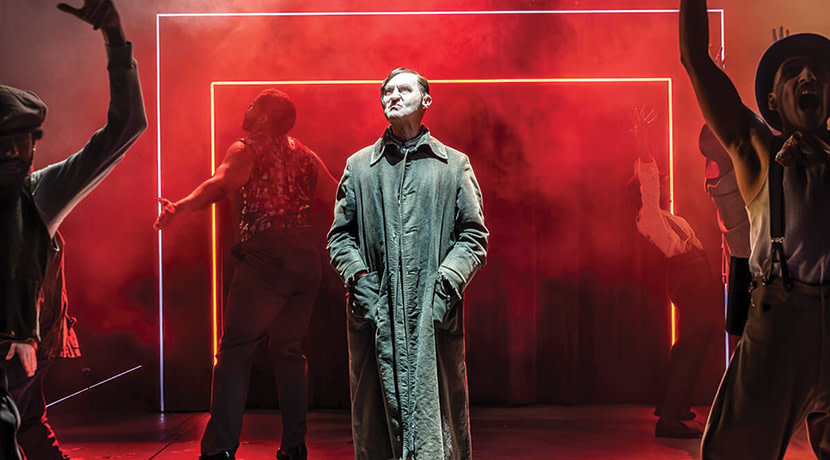
Equal parts ostentatious gangster tale and bitingly pertinent historical satire, The Resistible Rise of Arturo Ui shows at the Swan Theatre at the Royal Shakespeare Company (RSC), until Saturday 30 May. Featuring a masterclass from Mark Gatiss in the title role of Arturo Ui, surrounded by an exceptional supporting cast, the play tracks Hitler’s rise to power, transplanted onto the story of Ui - a violent and ambitious gangster - and his influence on the Chicago cauliflower trade.
From the first moments of the play - an introductory prologue and crowd warm-up by stand up comedian and actor Mawaan Rizwan - the tone is set for something extraordinary. Rizwan, who also plays Giri, one of Arturo Ui’s chillingly energetic henchmen, calls to the stage a company of clowns. Literally - they are decked out in exaggerated make up and shambling costumes, skillfully designed by Georgia Lowe.
These are Ui himself and his cronies, scraped from the underbelly of society - pushy, monstrous, gregarious and violent - with universally impressive performances (the same can be said about the whole company) by Cameron Johnson, Kadiff Kirwan and L.J. Parkinson, alongside Rizwan.
Christopher Godwin plays Dogsborough, whose position and corruptibility allows Ui’s campaign to gain leverage, while Mahesh Parmar has a scene-stealing turn as Dogsborough’s son - comedy and tragedy nestle together, in a play which offers up real history alongside a surreal setting, and as many laughs as there are tense silences.
The plot is slick - Bertolt Brecht’s play is translated by Stephen Sharkey, and the historical touchstones sit side-by-side with moments shockingly relevant to the present day. Gatiss begins the play as a grotesque gangster, and transforms into a tyrant - his transformation is both an alarming portrait of social manipulation, and a reminder that the character is just a man, whose tyranny could have been halted at any turn.
The design of the production is bold and effective, with dramatic lighting by Robbie Butler which often merges beautifully with the music - the score is newly written by alt-rockers Placebo, and performed from atop a central set piece under the musical direction of Richie Hart. Seán Linnen, as director, extracts every ounce of meaning from the play, and entirely makes use of the Swan’s unique, immersive setting.
One of the crowning successes of the production is that it is custom-built for performance at the RSC. From pertinent Shakespearean references to the design, which was made to be set against the backdrop of the Swan, this is not only a timely staging of Brecht’s play, but a triumph for the RSC creators, on and off the stage. The Resistible Rise of Arturo Ui is vital theatrical viewing - catch it at the Swan while you can.
5 Stars on Tue, 21 Apr 2026