
More Theatre News
-
Feature: One Tiny Penguin at Birmingham Hippodrome
Posted on Wed 04 Nov
-

Amanda Root talks about her roles in the RSC's Middlemarch
Posted on Mon 02 Nov
-
Mamma Mia opens at Wolverhampton Grand
Posted on Wed 28 Oct
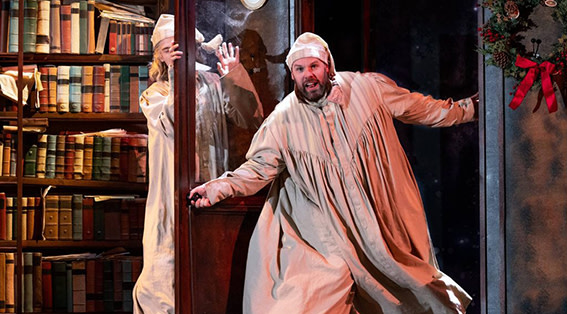
Mischief Theatre brought us The Play That Goes Wrong nearly 25 years ago. With its blend of loveable characters and slapstick comedy, it introduced us to the would-be thespians of the Cornley Amateur Drama Society - whose every show is a disaster.
After the huge success of a string of comedies over the past two decades, all created by the writing trio of Henry Lewis, Jonathan Sayer and Henry Shields, Mischief has now turned its attention to a festive classic with Christmas Carol Goes Wrong.
The show premiered last year, with a successful run over Christmas in the West End, and now it comes to Wolverhampton Grand Theatre this month.
Actor Dave Hearn, who has been a member of Mischief since its beginning, says audiences can expect that signature brand of mayhem which the company is so clever at creating.
“Christmas Carol Goes Wrong is a comedic retelling of a Christmas classic [Dickens’ A Christmas Carol],” he says. “And the exciting thing about this version of the story is that you get a bit of an insight into the Cornley characters as well. So you see them auditioning, rehearsing, at production meetings - and that serves the dual purpose of getting to know the characters a bit better and also being able to understand why some things in the show happen. And I think the joy for the audience in this one is getting to see how the sausage is made, but from a Cornley perspective, not just a Mischief one.”
So as the dramatic society attempts to stage A Christmas Carol, just about everything goes wrong. And with Mischief having built its reputation on its comedies, Dave says part of the joy is that the audience too has become a participant.
“Our audiences now are ready for it to go wrong. And so for us as actors, we have to be careful not to pounce on that too quickly, because one of the joys of these shows is the build of the comedy throughout the show, so that hopefully, by the end of it, everyone is in such hysterics that we're not even really delivering jokes anymore. People are just laughing at the rhythm of the show.”
It also helps when the audience are familiar with the play the Cornley team are producing - and what it should be.
“It's very useful from a comedic point of view to tell a story that people already know. Then you can disrupt it in a way that is much, much easier because audiences understand what was supposed to have happened.
“With A Christmas Carol, they understand particularly the three ghosts and the tropes of that. It means we can play with it and subvert it in a way that feels really, really fun. And in a way, a lot of the comedy comes from not actually subverting the expectation; in just doing what is written, and you're watching these idiots try and do it.
Dickens’ classic was an obvious choice for the company to subvert.
“A Christmas Carol is, at its heart, a very simple story to tell. But there's also a darkness to the story, and it does take itself quite seriously. And so it's really ripe for undercutting and undermining that seriousness.
“Plus, when you’re in a theatre show, you get so much for free at Christmas. People are in a good mood, they’re excited to come out, and it's a really good time for comedy.”
Dave plays Max, who in turn takes a whole host of roles in A Christmas Carol.
“I think Max has a total of about 17 parts, but the main ones are a debtor and also a younger version of Scrooge. Max is very happy-go-lucky. I think he's extremely innocent in his outlook on the world. He's a victim of being quite fortunate. He sort of stumbles into things and his life just kind of goes quite well for him.
“The reason he's with Cornley is just because they're his friends and he loves doing the shows with them. Me and Henry Lewis had a joke a very long time ago, while we were doing some improv backstage, that Max had actually been offered the chance to play Hamlet at the National Theatre but had turned it down because he was, like, why would I want to do that? I get to do this show with my friends; I don't know anyone at the National.”
Max is an audience favourite. “For all intents and purposes, he’s a very good actor. He's just so overwhelmed by the audience, kind of distracted by them, and can't get over his love and joy of them. And I think that's where most audiences connect with him.
“From an acting point of view, you almost want the audience to leave feeling as though, had they not been there, Max's performance would have been totally different; that they’ve had an influence on how the show has turned out. That’s one of the most fun things to play with different audiences.”
Dave is a familiar face to Mischief audiences, both from the company’s theatre shows and its television series The Goes Wrong Show. And, he says, working with the company is very special: “I’m similar to Max, actually. I've been very fortunate to be offered some other work that I've turned down to do shows with Mischief because I get to do them with my friends. The idea of exploring a new work with this company of people who I love and who I trust is always so exciting. We have an alchemy between us, so we can hotwire connections to jokes, and also it just means it's more fun. If we can still make each other laugh after nearly 20 years, that's pretty special.”
Dave is looking forward to returning to Wolverhampton Grand with the company: “The first time I went there, I have a distinct memory of stepping onto the stage and I think I actually audibly just went ‘Wow!’, because the theatre itself was so beautiful. I really remember that the audiences for The Play That Goes Wrong were very new at the time, and so nobody really knew what it was.
“The audiences, particularly at Wolverhampton, took a real chance on us and the show, which helped us realise that we had something pretty special because they were just so engaged and so happy to be there. We were like ‘Wow, Wolverhampton's popping off!’ And so we're excited to come back and do a show there again.”
Feature by Diane Parkes
Christmas Carol Goes Wrong shows at Wolverhampton Grand Theatre from Tuesday 10 to Saturday 14 November. The show then returns to the region to play Birmingham’s Alexandra Theatre from Tuesday 16 to Saturday 20 February 2027