
More Theatre News
-

Feature: Scare-Raising
Posted on Wed 23 Sep
-

Feature: Snow Business
Posted on Wed 23 Sep
-

Feature: Welcome To Burlesque
Posted on Wed 23 Sep

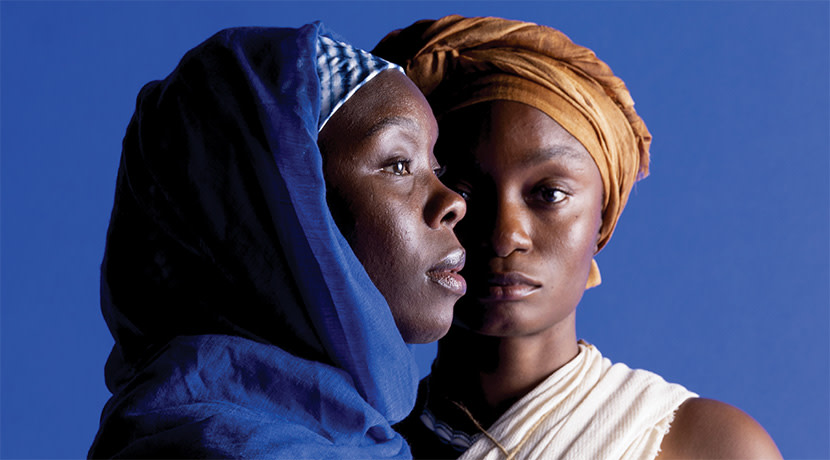
An award-winning new play about the unlikely friendship between a slave and her former master in pre-colonial Nigeria visits the region this month. Once Upon A Time In Sokoto is a powerful family drama set against the backdrop of traumatic real events - as its writer, Inua Ellams, tells What’s On...
“It’s just a period drama from another world - and the British public love period dramas, right?”
Poet, playwright & artist Inua Ellams is delighted to have found a simple way to describe his new play, Once Upon A Time In Sokoto, the epic nature of which could otherwise have made it a potentially trickier sell. The family drama, which won the 2024 Alfred Fagon Award and tells the tale of an unlikely friendship forged between two women - a slave and her former master - is set against the backdrop of events that led to the creation of Nigeria. The women come from totally different backgrounds but overcome their differences to develop a strong bond in the face of new, bigger enemies.
“[It’s] a relationship which is forged just as personal and political worlds tragically collide,” he says, noting that the play “explores power, faith, heritage and culture”.
“It’s a period drama set in mid-late 1800s pre-colonial Nigeria, and I’ve always been fascinated by how the legacy of this time still influences and resonates with global perceptions and politics today.”
Money and power also play a major role in the saga, which spans a period of 65 years.
“It’s mostly about business actually,” he admits, almost apologetically. “It’s about trying to trade, trying to make money. And the backdrop is religious differences, cultural differences, class, commerce, love, relationships. It’s an epic story but told through the lives of four people who lived through those incredible times.”
Ensuring those times are accurately reflected meant Inua, who was born in Nigeria, spent three years researching the play. He instantly faced problems, as many historical records from the time no longer exist.
“A lot of them were systematically destroyed by British colonial forces, and a lot haven’t been translated into English. What exists I found in library books which you aren’t even allowed to take out. I read between 30 and 40 books, academic research, novels, papers and dissertations, and also spent time interviewing historians and lecturers in Northern Nigeria.”
The idea for the play actually came about while the writer was working on an entirely different project.
“Six or seven years ago, I was researching another play and I discovered [the origins of] extremist forces in Northern Nigeria that have been plaguing the country since I was a kid. They’re popularly known as Boko Haram, but that’s not what they called themselves; it’s the name the CIA gave them.”
The jihadist militant group’s name literally translates as ‘Western education is forbidden’, but the phrase was initially used to describe a way to defend or protect native Northern Nigerian culture. This was partly in response to having a new alphabet imposed on the people when the region started to become incorporated into the British Empire.
“In order to successfully impose a new alphabetical system, they had to destroy the system that existed beforehand, and that’s what was used to write down court records, religious teachings, mathematical equations, business records and so on. It was the language of government, and it was essentially Arabic script.
“When the British came over and destroyed everything, they said ‘You are going to use Boko to write everything,’ and a lot of leaders thought ‘Using Boko [fake/Western script] is haram [forbidden]’. That’s the first time the phrase was used.
“The CIA misconstrued its meaning, and that fed back to the country and became what it is now. But that was what sparked off the whole play.”
But as much as societal and political upheaval provides the backdrop for the play, there’s a universal, human story at its core. Inua says he worked hard to strike a balance between factual accuracy and dramatic entertainment: “That was one of the tensions, one of the challenges as a writer. I don’t want people to come and watch it as [pure] fiction, or to think of it as fantasy. A lot of the things that happen [in the story] actually happened.”
That said, he’s happy to acknowledge there’s plenty of entertainment to be had along the way too: “There are sword fights, battles, a love triangle… an older woman versus a younger woman, a younger man versus an older man… all the sorts of tropes we’d recognise from contemporary culture, cinema, television and stories.”
The unlikely relationship between the two main characters - another key element - was partly prompted by Inua wanting to acknowledge the different way slaves were treated in Africa.
“A lot of far-right voices in British media and academia justify the transatlantic slave trade by saying ‘Oh yeah, well you guys enslaved each other in Africa.’ They’re right, we did, but slavery within the African continent was very different. Slaves could marry into the family that enslaved them, sue their masters for maltreatment, demand time off work, work off the debt of slavery. They could even go on to own the businesses and become leaders of the family.
“So it was a status that was protected by law and human rights, and slaves weren’t enslaved for the entirety of their lives and generations after, which is what happened in the West. I was trying to explain that, and it’s another of the things that led me to create this story.”
The play is also very personal to Inua, who drew on his own family and experience for inspiration.
“I was born in Northern Nigeria, so some of the places in the story are places I grew up in. I also grew up in a feminist household - I have three incredible sisters, which is why I wrote three sisters.
“One of the things that drove me to write the play was trying to look at Islam and pre-colonial Nigerian life with a very keen feminist eye, but also to understand [all of] that in the context of masculinity and power, which worsens pretty much everything.”
Even though the play is set in Nigeria over 200 years ago, Inua sees plenty of parallels with contemporary western society.
“Oh so many... one of the things I discovered was women were still arguing for the right to decide when they were going to have children - or refusing to do so - and the societal repercussions of that. We’re seeing this right now right across the West, with birth rates falling in the UK, across Europe, America. But any time a woman does that, it can create a huge backlash within a community or family. So there are direct parallels between what happened 200 to 300 years ago and what’s happening right now.
“One of the tragedies of the play is that not much has changed. Sometimes, humanity [makes me] despair - I just think we should have evolved past so many of these things already. We should have fought harder and done better, but we’re still here.
“That’s just some of the frustrations, but I think the play engages with them in a very new, interesting, dynamic way.”
Once Upon A Time In Sokoto shows at Warwick Arts Centre, Coventry, from Thursday 5 to Saturday 7 November.
By Steve Adams